Friday, June 19, 2015

Fact: Buffalo Buffalo Buffalo Buffalo Buffalo Buffalo Buffalo Buffalo is a Full Sentence.

After the end of the Civil War, some black Union soldiers found that they wanted to continue fighting, and so they permanently enrolled in the Army, a first for people of color. However, because segregation and racism were still a thing, they were put in the United States Colored Troops. These soldiers, though kept at arm's length from the rest of the country, would eventually earn the name buffalo soldiers. As the 1860s and 1870s rolled around, America started to head out west. Though native Americans had already been moved from their lands by Andrew Jackson during his presidency in the 1830s (I talk about the Trail of Tears back in December), they were once again a target. Although some wanted them simply wiped out, others attempted to assimilate these cultural outsiders into society. As a result, government action varied widely. The essential question we determined was: During westward expansion, did the impact of federal policy towards buffalo soldiers and Native Americans match the intent? The class took notes on videos and primary sources surrounding this topic and congregated them in a single Google Doc to determine the answer to the question.

When it came to the buffalo soldiers, the government's impact didn't match what it meant to accomplish. What it meant to accomplish was likely the superficial inclusion of black troops while in actuality placing them far below any white soldiers. In a sense, they did succeed; the buffalo soldiers went out west, doing tough jobs that no one else was willing to do, while at a disadvantage with low quality supplies. Yet, at the same time, the strength of the buffalo soldiers drew the respect not of whites, but of Native Americans, who gave the the name buffalo soldiers for 1. their resemblance to buffalo in their hair and 2. their fierce fighting spirit like that of a wounded buffalo. It has also earned them a modern legacy of courage and bravery. Superficially, the government at the time accomplished what they wanted in making things rough for the buffalo soldiers, but in the end, the buffalo soldiers left their mark in history.
A map showing the stationing of buffalo soldiers. They
were mostly sent out west, where conditions were rougher.
As a result, buffalo soldiers were often the ones fighting
the Native Americans. Image source: www.wikipedia.org.

A chart showing government policy
on these groups over the years.
Link to enlarge is on the left.
On the other hand, the government ultimately got what it wanted when dealing with the Native Americans out west: getting rid of their cultural presence. General Sherman, back from the Civil War, used his total war tactics on the Native Americans, wiping out the tribes by getting rid of their horses and the buffalo that they relied on. Less annihilitory tactics tried moving the tribes onto reservations, and then attempting to assimilate them into white culture by telling them to farm, in the form of the Dawes Act (1887, excerpts here), which split reservation land into sections for the residents to farm on.  Eventually, things came to a head in 1890 with the Wounded Knee Massacre, ending with more than 150 Sioux killed and ending Native American resistance to white culture. (from this nice little chart here) With the Native Americans out of the way, the U.S. was free to expand westward.

I think the class managed well enough on our own this week. We got through the material a lot quicker because we knew what we were doing, and read in small groups rather than out loud as a class. It's a nice class format that feels more relaxed, but I'm not sure if I'd want it all the time, since the class sometimes had a little inertia in productivity.

Friday, June 5, 2015

(Sidenote: I Always Thought Carnegie Hall Was Named for a Musician)

Rockefeller in 1885. Doesn't
the mustache just scream
"business superpower"?
Image from wikipedia.org.
During the second half of the 19th century, America experienced a period of major economic growth known as the Age of Industry. Most of this was driven by top businessmen who represent some of America's wealthiest men in history, like John D. Rockefeller and Andrew Carnegie. These men, known as captains of industry, gave generously to charity, education, and the public. Yet, these same men were also accused of shady and unethical business practices like bribing politicians, earning some of them the nickname of robber barons. The essential question for this unit, which we came up with as a class, was: Were the captains of industry a positive or negative impact on the public? To learn more, the class watched a series of videos and analyzed some sources surrounding two of the most important and famed captains of industry, John D. Rockefeller and Andrew Carnegie. (Bios for the two: Rockefeller Carnegie)

Andrew Carnegie, leader of the
steel industry and philanthropist.
Image from wikipedia.org.
While I approve of both Rockefeller and Carnegie's ideals and goals, I think their business practices were unethical and ultimately impacted America negatively. Rockefeller ran the Standard Oil Company from Ohio, and eventually became one of the biggest businessmen of the country, all while donating millions of his money to charity and education. How he got to the top, however, was somewhat questionable; one of his business tactics was to drop prices low and take the loss until rivals went out of business, at which point he would drive prices up. This is a very effective business tactic, but I don't approve because it destroyed competition rather than taking part, and created a monopoly on oil. Carnegie falls in a similar boat; a wealthy philanthropist whose workers are paid incredibly little for grueling work is somewhat contradictory. Carnegie, who headed the steel industry, attempted to destroy steelworkers' unions. This partially led to a fiasco known as the Homestead strike. (We watched a video on it here.)

I stand by my opinion, but I think it is important to recognize that captains of industry were actually pretty good people, like donating money to the public because they truly felt that it was a moral imperative for the wealthy to give back. One of them, J. P. Morgan, personally bailed out the government on more than one occasion. But this is not about the character of these men, it is about their effect on America. Low worker wages, shady business practices... They treated America as a whole very well, but screwed over a lot of people in the process.

This unit was somewhat challenging because the class was collaboratively learning without the direction of a teacher; the sources were analyzed, notes were taken, and the essential question was proposed as a class, following the plan that Mrs. Gallagher gave us. Some students started taking leadership roles, and I think that also helped. We were somewhat inefficient in our work because we were getting used to the process, and I think we should be able to improve when we do this again for the next units.

Tuesday, May 5, 2015

Above, Below, Up Down Left Right

Continuing our unit on the Civil War, our class examined the progression of African American freedom during the time period. The essential questions for this lesson were: Who "gave" freedom to enslaved Americans? Did freedom come from above or below? To what extent were Abraham Lincoln's actions influenced by the actions of enslaved Americans? Freedom from above indicates that people in positions of power are the ones who brought about change, while freedom from below indicates that the actual group of affected people got up and did something about their situation, bringing about their own change. We looked at 6 different sources and decided if they showed freedom from above or below. On our new whiteboard surfaces, we put the sources in order of what we thought they showed.
The 6 documents, with a brief analysis, are put in order here. The top 4 documents, from Lincoln, can be found here,
while the bottom 2, on African Americans in the Civil War, are found here.
Overall, freedom came from below in this case. Though Lincoln was the one that did the actual freeing part, his documents show a slight reluctance to follow through with this; he takes multiple baby steps before going all out with freeing the slaves. Instead, African Americans forced the issue here, making themselves a visible problem to the Union, who needed to deal with them somehow.

I feel that a similar "freedom from below" situation can easily be seen LGBTQ community. After such a prolonged period of stigma and oppression, it's nice to see them getting some visibility today, like the Bruce Jenner interview in recent news. I'd say this is freedom from below, considering how hard the LGBTQ community has worked the get their message out, especially with some federal governments' reluctance on the subject of gay marriage. The dichotomy of freedom coming from above or below, while not necessarily black or white, is an interesting way to look at any major change in the rights of a group of people.

Friday, April 10, 2015

Sidenote: Chattanooga is a Great Name

The QR code leading to the battle
information on the Chattanooga
Campaign.
To learn about the Civil War battles throughout the course of history, our class did a scavenger hunt. This lesson had two essential questions: Who was the ultimate victor in each the theaters of war: East West, and Naval, and what are some commonalities you can identify in the reasons for the results of the battles? Each student (with a few pairs) received a battle to research and create a short summary of, including the theater, who won, and the reasons why. My battle, the Chattanooga Campaign, can be found here. Each battle then created a bit.ly link and corresponding QR code. Each battle was posted in different spots around the school with the QR code ready for scanning, including the battle information and directions to the next sign. Everyone, equipped with devices, went around taking notes on each battle. Afterwards, we examined this map here which gives many examples of Civil War battles. We then used a Padlet to post our thoughts on who ultimately won in each theater of war. The Padlet is down below.

The North definitively won both the west and naval theaters, but the east theater was a little more back and forth. In the West, the confederacy lacked the supplies to win much, giving the Union the advantage. On the sea, the Union had better equipment and stronger troops, while the confederacy had mishaps like blowing up their own ship. At the beginning, poor leadership in the North gave the South an edge in the East. But after the North took the Mississippi River, splitting the South, and changed leadership from weaker generals like McClellan to strong leaders like Grant and Sherman, the North began to win.

Wednesday, March 25, 2015

Spoiler: Lincoln Wins

Our class was learning about the Election of 1860, one of the big events that helped spark the Civil War. The essential question was: How were the results of the Election of 1860 representative of the deep divisions over slavery? This presidential race was unusual, in that 4 major candidates ran instead of 2. But what importance does this event hold in U.S. history? To start, we got into small groups and read through this webpage here to learn about the Election of 1860. We took the images that the site used and saved them, taking notes on how each picture fit into the story of the election and its aftermath. We also used Educreations, placing the site's images (and a few that we found on our own) and narrating with our understanding of the Election of 1860.


(technical issues with the title slide and end slide citations. This project was done by myself, Brian Biggio, and Sean Margossian. Sources are below.)

http://www.civilwarinart.org/exhibits/show/causes/introduction/the-election-of-1860-and-seces
http://en.wikipedia.org/wiki/John_Bell_(Tennessee_politician)
http://en.wikipedia.org/wiki/United_States_presidential_election,_1860
http://en.wikipedia.org/wiki/Abraham_Lincoln

Monday, March 16, 2015

(Alternative Title: The Stats and Strats of the Civil War)

The most recent lesson for the class was learning about the sides of the Civil War, their positions and their strategies. The essential question was: How did the differences between the North and South affect each region's strategy and success in the Civil War? The information we got was analyzed and placed into an infographic, using sites and apps like Infogram, Piktochart, and Canva.

I didn't have much of a hard time choosing information to put in the graphic; I put in anything that I thought was interesting, useful, and relevant to the topic, and also was easily represented in the form of a chart or something similar. My two harder choices were on what application I wanted to use. I tested all three choices. Canva is nice, but not really suitable for a vertical infographic like what we needed. Piktochart and Infogram are roughly level, but I ended up choosing Piktochart mostly because I liked its map feature better (which I used in the infographic a lot). My second difficulty was presenting the information in an aesthetically pleasing way. I had a lot of problems with silly things like color palettes- I used blue for the Union and gray for the Confederacy, but it mostly made a dull color palette, and I had problems making it look more exciting. Overall, though, I found the project really cool, and if I need to do a digital project with anything of this sort, I will probably resort to one of these three applications (Canva looks incredibly versatile).

The information presented gives clear insight as to the situations that each side faced at the start of the war. It's fairly obvious that the North has most of the advantages, having more people and resources to work with, but the South also has a few contextual advantages, like being the defensive side of the war and supplying a lot of the world's cotton.

Thursday, March 5, 2015

An Elephant in Time

Our class's latest lesson was on the events leading up to the Civil War. The essential question was this: how do we know the debate over slavery was the "elephant in the room" for American politics in the early 19th century? We spent time learning about 8 events and putting them in a timeline, with events in favor of the north and anti-slavery advocates on top, and events in favor of slavery and the south down below. Some events had multiple parts, so there are multiple branching lines from a single dot.

The timeline itself. Events on the top half favor anti-slavery
advocates, the bottom half favors pro-slavery advocates.
This secondary part of the timeline includes descriptions of
the events pictured above.
The answer to the essential question is that politicians, rather than directly facing the dividing issue of slavery, made concessions and compromises on the minor issues that came up, thus skirting around the big issue at hand. The Compromise of 1850 consisted of five parts, some in favor of the north and some in favor of the south, so as to not upset the balance of free vs. slave states in the Senate. But by leaving some territories open to either side in the compromise, legislators set up a race to populate these territories. The Kansas-Nebraska Act shows the result; the north wanted railroad access to western territories to populate those areas with anti-slavery settlers, and so they gave slavery a chance to grow north through those territories in exchange. This directly led to what became known as Bleeding Kansas. The Kansas settlers, torn between free-soil and pro-slavery ideals, became immersed in a near-civil war. Even two capitals were formed; Topeka for free-soil, Lecompton for pro-slavery. And yet, nothing came to stop it because nobody wanted to address the issue. The John Brown raid also shows politicians only taking an issue at face value and not addressing the underlying problem: John Brown, having raided a federal arsenal with the intent of starting a revolt of slaves, gets hanged for treason and nothing else happens, only a rising of tensions between the north and south.

This elephant in the room topic is interesting to see how politicians react to the issues, big and small, and how to recognize an elephant in the room situation and deal with the elephant first and foremost. The RWT Timeline app was fun to use, but fairly limited with a history of crashing. I like these types of activities, but perhaps on a different platform next time.

Tuesday, February 24, 2015

Slavery: The Numbers and the People

One of the greatest historical stains of the USA is the existence of slavery until the Civil War. From colonization until abolition, slavery was an integral part of America's foundation. As such an integral part of American history, it deserves a little in-depth examination.

This interactive map showed a side-by-side comparison of the growth of
the cotton industry and the growth of slavery. The correlation here is
strong, especially seeing the section in Louisiana appear on both maps
at the same time in the same area. Source: Mapping History
Slavery had long-been established in America, but during the late 18th century, it seemed to be in decline. Masters were increasingly freeing their own slaves as ideals of liberty and equality grew. Eli Whitney's invention of the cotton gin revitalized the industry. The cotton gin was a machine that separated the seeds out of cotton plants, making cotton production much easier. With this boost in cotton brought a boost in slavery: the first decade of the 19th century saw a 33% increase in the slave population. And by 1860, cotton made up 57% of US exports, up from practically nothing in 1790. With cotton such an important part of the US economy, slavery by extension became entrenched in American society.

To get past numbers and really look at the human aspect of slavery, it might be helpful to look at the story of Abdul Rahman, a prince from the African region of Futa Jallon who was captured from his home, shipped and sold to slavery in Natchez, Mississippi (our class notes during the documentary of his life can be found here). The slave ship Rahman was on had all slaves chained below deck, with little water and so crowded that some died and the crew didn't even notice. When he was being sold in Natchez, Rahman was physically examined like everyday goods: he was felt, looked up and down and asked to open his mouth before he was sold to Thomas Foster, a small plantation owner. Refusing to work, Rahman, or "Prince" as he became known, was beaten by Foster. The conditions that slaves were put in during the time period were exceedingly harsh, and they were treated as far less than human, crushing their human dignity.

The institution of slavery ignored the humanity of those who were enslaved as well. When Rahman tried to tell Foster his story and get freed, Foster instead mocked him, which is what gave Rahman his nickname for the rest of his time in America, "Prince." The way in which slaves were captured ignores the fact that these were people who had lives, completely uprooted and forced into a rough lifestyle. A similar situation occurred when Rahman left America, having been freed from enslavement. He had found a wife and had had kids during his time on Foster's plantation, but he had to pay to free his wife, and he couldn't raise the money to free his children; they were left enslaved while he and his wife left back to Africa. Rahman's story shows a lack of human empathy for those who were seen as "below" people, which was really the root of the problem with slavery: placing some people below others in organized society for trivial matters.

Monday, February 2, 2015

Women's Rights (and also Pantene)

19th century was a time for change in the United States. As more and more activists spoke out to provide equal rights in the land of opportunity, America began to be shaped into what we see today. But all change is controversial. One of the most controversial movements was the reform of women's rights. A woman lacked a lot of rights in those days: her right to own property, divorce her husband, vote, and even custody of her children if her husband appointed another guardian in his will.

The Recorder's article gives criticism of the Women's
Rights Convention and then gives an excerpt of the
Declaration of Sentiments and Resolutions.
Larger image here. From Library of Congress,
http://www.loc.gov/exhibits/treasures/images/vc006198.jpg
In July of 1848, many gathered in Seneca Falls, New York, creating the Declaration of Sentiments and Resolutions as a cry for women's rights. Reactions from all around the USA were widespread, and varied from supporting the movement to outright condemning it. One newspaper, The Recorder, published a piece on August 3rd concerning their opinion of the convention stating, "We need not say that we think the movement excessively silly..." However, others spoke up in support. In response to articles like The Recorder's, The National Reformer
published this statement on August 31: "But to be serious– we would like to be informed why– we would ask but for one valid reason why woman should be deprived of her equal rights as an intelligent being."

Even from the 19th century, I think we still have a similar problem today. Although not to the extremes of some back in 1848, gender can have an effect on how society views someone in the 21st century. This advertisement from Pantene gives some examples, like someone dressing nice can be seen as smooth or a showoff depending on their gender. However, I think this ad also serves as proof that these differences are getting recognized and we are slowly making steps to improve the situation and bridge the gender gap.


This ad, from Pantene, displays traits that society labels men and women differently for. Source: https://www.youtube.com/watch?v=B8gz-jxjCmg

Sunday, January 11, 2015

Report on the Insane

"The conviction is continually deepened that hospitals are the only places where insane persons can be at once humanely and properly controlled. Poorhouses converted into madhouses cease to effect the purposes for which they were established, and instead of being asylums for the aged, the homeless, and the friendless, and places of refuge for orphaned or neglected childhood, are transformed into perpetual bedlams. . . .

Injustice is also done to the convicts. It is certainly very wrong that they should be doomed day after day and night after night to listen to the ravings of madmen and madwomen. This is a kind of punishment that is not recognized by our statutes, and is what the criminal ought not to be called upon to undergo. The confinement of the criminal and of the insane in the same building is subversive of the good order and discipline which should be observed in every well-regulated prison. . . .

Gentlemen, I commit to you this sacred cause. Your action upon this subject will affect the present and future condition of hundreds and of thousands."

Dorothea Dix, a 19th century
social reformer. Dix advocated
for improved conditions for
the mentally ill.
Image from www.wikipedia.org
During the 19th century, mentally ill people were not treated well; they were kept in prisons with criminals, left in poor conditions, and many were chained and beaten. Dorothea Dix, an advocate for reform of this treatment, grew up with a mentally ill mother and an absent father, being raised mostly by her grandmother. Dix supported the idea that the mentally ill should not be incarcerated and should instead be placed in hospitals and asylums to try and cure them. As Dix spent 18 months examining conditions in Massachusetts jails and poorhouse, her claims are trustworthy. However, they may be slightly biased to make conditions seem worse than they were at the time, since this speech was presented to the Massachusetts legislature to improve conditions for the mentally ill. While this excerpt shows Dix’s arguments, it does not show the whole picture, as Dix shared many shocking stories of families affected by poor treatment of mentally ill. Dix uses her own observations to support her argument. Her use of logical progression of thought and emotionally provoking statements create an overall impression to the reader that the system is unfair and should be reformed. It was an effective impression, as the Massachusetts legislature eventually expanded an asylum, and Dix went on to inspect conditions of mentally ill prisoners in many other states.

American History, s.v. "Dorothea Dix: Report on the Insane (1843)," accessed January 11, 2015. http://americanhistory.abc-clio.com/.

Thursday, December 11, 2014

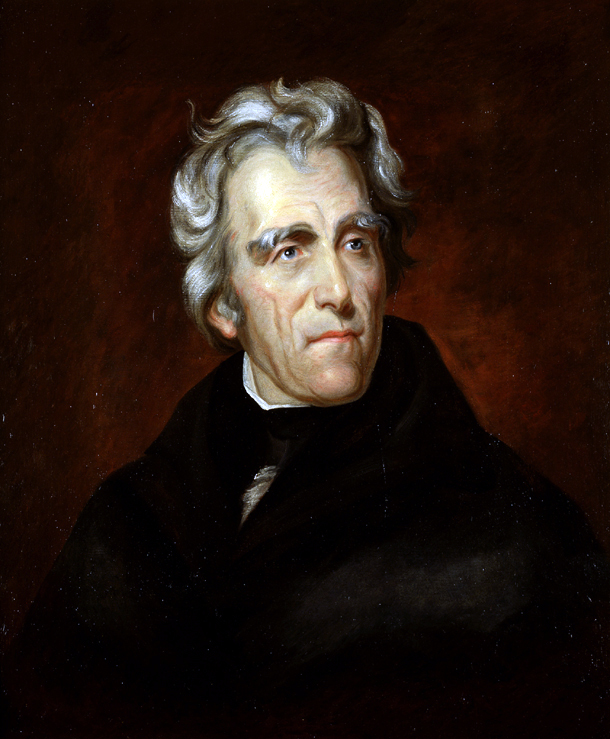
The War of the Banks (Directed by Andrew Jackson)

Andrew Jackson, the 7th
president of the U.S. Image
from wikipedia.org.
This lesson centered on the presidency of Andrew Jackson. Jackson has a reputation as “the people’s president,” but a look at some of his actions reveals that there might be more to the story. The essential question was: Is Andrew Jackson's long-standing reputation as "the people's president" deserved? We split into six groups, two for each topic. Each created a presentation to show the class about the three issues of the time, and used the evidence to indicate whether or not Jackson was the people’s president or not. Our group used Chatterpix in conjunction with Videolicious to describe the Bank Wars (part 1 and part 2).

The first issue, about the Trail of Tears, concerned the removal of Native Americans off of their land and their migration west. Jackson said that they would be safer out west rather than clash with Americans in the east, but he moved them by force, and many of them died even before they left, in concentration camps. The second issue, concerning the second national bank, became known as the bank wars. Jackson thought that the bank had too much control over the economy and only supported the rich, but vetoing its charter eventually caused an economic collapse known as the Panic of 1848. The final issue concerned what became known as the spoils system, in which people are encouraged to lean towards a political party by giving them positions of power. This eventually resulted in a million dollars being stolen by one of Jackson’s supporters.

Thursday, December 4, 2014

Early America: A Somewhat-Kind-Of-A-Democracy?

This lesson centered around early American democracy. The essential question was: How should we define democracy? How democratic was the United States in the early 1800s? Using online searches and our own knowledge, our group defined democracy as a system of government in which power distributed to law-abiding citizens by giving them the right to vote for their leaders. We analyzed sources such as a painting by George Caleb Bingham, quotes and documents from people of the time about the voting system, and various charts. The analyzed sources were put on this poster to illustrate how democratic the United States was at the time. The final verdict was that American democracy was underdeveloped at the time, but was rapidly improving.

Our poster. Each of the 5 sources got their own slip to put in the ballot box for how democratic the US is. Each
ballot has the source's analysis and a rating based on the source.

Tuesday, November 25, 2014

Revolutions About Race (Exhibit A: Latin America)

The essential question for this lesson was “Why is it essential to acknowledge human value regardless of race? How are the events in the Latin American Revolutions evidence of this social imperative?” This is an important question because the idea of recognizing someone’s humanity regardless of their race is an idea that has not entirely sunk in today. We studied the impact of race in the Latin American Revolutions through three countries: Mexico, Brazil, and Gran Colombia. In the time period, there was an entire social structure based on a person’s heritage and where they were born, stretching from peninsulares (native Spanish people) to the African slaves. Each group of the class got a revolution to create a timeline of events for and then shared with the other groups. By examining these revolutions and comparing them, we answered the essential question.

A commonality among all three of these revolutions was that they all gained independence for
Our group did our timeline on the events surrounding Gran
Colombia, a short-lived republic that included modern-day
Colombia, Venezuela, and Ecuador.
themselves from European rule: Brazil from Portugal, and Gran Colombia and Mexico from Spain. They all also had more than one leader to guide them, like how Gran Colombia had both Simón Bolívar and Antonio José de Sucre. However, these three countries took different paths to independence. Gran Colombia became a republic, but Brazil became a constitutional monarchy, while Mexico became a constitutional monarchy that eventually got overthrown and replaced with a republic. Additionally, they had different types of leaders. Gran Colombia and Mexico had Creole leaders for the most part, while Brazil had a peninsular to lead them. Race was a major player in these three revolutions. In Mexico, the majority of the army was made of people who had been suppressed by the relatively small number of peninsulares, feeling that they had just as much rights as the Spanish. After its revolution, Brazil, being ruled by a peninsular who filled the government with other peninsulares, opposed the ruler that had been put on the throne and had him abdicate, since they still weren’t getting the fair representation they wanted. Gran Colombia referred to Simón Bolívar as “the Liberator,” which would indicate that under the oppressive social structure imposed on them by Spain, they didn’t feel free, and so rebelled for their freedom.

Latin America was not the only region of the world where race became a major issue, and race is still a significant issue in our lives today. There is no caste system in America like there was in the Latin American countries before they rebelled, but the issue of race manifests itself in other ways. Just take for example the recent events in Ferguson, Missouri, a hotly contested and polarizing topic at the moment. Problems like this are signs that we still have a lot to learn about how we deal with race. We don’t necessarily need a revolution to change, but a change right now would be revolutionary.

Friday, November 21, 2014

How Should We Remember Toussaint Louverture?

The first independent country in the New World was, of course, the United States in 1776, achieving independence from Britain. But interestingly, the second New World region to reach freedom was Haiti in 1804. Like the United States, Haiti was originally a colony, and it took a revolution to reach independence. A French colony under the name Saint Domingue at the time, Haiti was inspired by the ideas behind the French and American revolutions, and built their own revolution against the slave work that went into sugar farming. At the forefront of the revolution was former slave Toussaint Louverture, who rose through the military ranks during the revolution and eventually became the first leader of Haiti. Just before Haiti was declared independent in 1804, Louverture was captured by Napoleon Bonaparte and died in jail in 1803. The father of his country, Louverture is known today as the first leader of Haiti, a liberator of the slaves, and a strategic military commander, but not necessarily in that order. Toussaint Louverture is a man that should be remembered first as a liberator of slaves, second as a strong but strict ruler, and then as a military leader.

By far, Louverture’s most important aspect was as a freedom fighter for the slaves, as it was one of the biggest parts of his life. His start came in 1791, when a slave revolt broke out in Saint Domingue. He started as a doctor, but also commanded a small group of soldiers against slavery. (Doc A) Joining the movement against slavery was the initial spark that led Louverture to the great things he did in life, and that spark burned for his entire life. Louverture’s goal wasn’t necessarily to achieve Haitian independence; as soon as the French abolished slavery in 1794, they dropped everything and began supporting the French again, even though they were still a colony. (Doc A) For Toussaint, everything, including military success, was secondary to the abolition movement. He was even willing to go up against one of the major powers of Europe to keep slavery abolished. When the French government that had abolished slavery was replaced by the conservative French Directory, it was feared that slavery would be reinstated in Haiti. To prevent this, Louverture sent a rather forceful letter, in which he states, “We have known how to confront danger to our liberty, and we will know how to confront death to preserve it.” (Doc B) This direct message says that Haitians will live free or die, as the saying goes. Because it was essential to his character, Toussaint Louverture’s strongest trait to be remembered is his determination in the fight for abolition.

Secondary to Louverture’s role in the freeing of slaves was his role as a strong but harsh leader of Haiti. He was involved in the making of the colony’s constitution when the slaves were freed, a constitution which put him at the head of Saint Domingue and “entrusted the direction thereof for the remainder of his glorious life.” (Doc C) This shows the people’s trust in Louverture to lead them well. One of Louverture’s most disliked policies as a ruler was the decision to continue sugar farming, which is labor intensive work. Though sugar was an important export and vital to the Haitian economy, the farming was work that the former slaves did not want to go back to doing, even if they were getting paid. Toussaint set strict rules on plantation workers in his proclamation in 1801, such as “Any manager or driver of a plantation upon which a foreign cultivator shall have taken refuge shall denounce him… within 24 hours under penalty of one week in prison.” (Doc D) His strict labor policy brought some to rebel against him, like his nephew Hyacinthe Moyse. Sympathetic with the former slaves who were against continuing the plantation work, Moyse allowed revolts to break out on the Northern Plain, as workers massacred white planters. Furious, Toussaint ordered an arrest and execution by firing squad. (Doc E) This was a harsh and somewhat cruel response, and while Toussaint was a good leader of Haiti, it is also important to remember his severity as a ruler. Although not the most significant thing to remember, Louverture’s position as the ruler of Haiti was key part of his life.

Toussaint Louverture was a great military commander, and it is also important to remember him as such. He was strategic, fleeing the French navy at the city of Samana and leaving them with an abandoned and burned-down town instead. (Doc F) He also taught his troops to fight in both guerilla tactics and European shoulder-to-shoulder style, giving them versatility for different situations. (Doc A) Through his knowledge of his race’s character, his humanity, generosity, and bravery, he earned the respect of his troops. (Doc F) He treated them as more than just soldiers, he treated them as fellow fighters in the battle for freedom, having given a speech where he refers to himself and the troops as “we.” (Doc F) While the military did not end up being the most crucial part of his life, it is another facet to his character that should be remembered.

Toussaint Louverture was a complex figure in Haitian history, with different facets of his life that should all be remembered, some more than others. He was most importantly the liberator of the slaves in Saint Domingue, as that was a goal that continued his entire life. Second to that was his controversial role as a leader of Haiti: he was a firm ruler, but perhaps too firm when it came to his policies on plantation labor. Finally, he was a great general, although that was a role that did not take strong precedence in his life. He was a chief figure in the history of abolition, and in world history, as a key part of the Haitian Revolution, the second free country of the New World.

Sources:
Doc A: Timeline created from various sources.
Doc B: Toussaint Louverture, "Letter to the French Directory, November 1797."
Doc C: The Saint Domingue Constitution of 1801. Signed by Toussaint Louverture in July 1801.
Doc D: Toussaint Louverture, "Proclamation, 25 November 1801."
Doc E: Madison Smartt Bell, Toussaint Louverture: A Biography, 2007.
Doc F: William Wells Brown, "A Description of Toussaint Louverture," from The Black Man, His Antecedents, His Genius, and His Achievements, 2nd edition, 1863. Engraving of Toussaint Louverture, 1802.

Sunday, November 9, 2014

And the Survey Says...

Our class’s essential question for this lesson was whether the Revolutions of 1830 and 1848 were failures, as many historians have decided. The Revolutions of 1830 and 1848 began in France, but the ideas spread to many other European regions, which also began to have their own revolutions. To determine the level of success/failure for each of the 5 revolutions we studied, we first made a small scale of complete failure to complete success and described what we thought each outcome would mean for the revolution. Then we, in groups, were each given a revolution to study, with a summary of events and primary sources. We used these to create a Surveymonkey on the revolution, which the other groups were given the information for and tested on to see how much they understood.

One of the questions of the Surveymonkey. Most
of the class got it right, citing that the Prussian king
was the enemy because he refused the crown and
constitution offered to him by the Frankfurt Assembly.
An 1848 caricature, titled "No Piece
of Paper Will Come between Myself
and My People." It illustrates King
Frederick William IV's refusal of
the Assembly and its constitution.
Source: Frankfurt Packet
Our group did the Frankfurt Assembly of 1848 (surveymonkey here). Germany, at the time, was not its own country, but rather a large group of German states, ruled by various princes. In 1848, delegates from the German states created the Frankfurt Assembly, an attempt to make Germany its own country. The Assembly eventually offered for King Frederick William IV of Prussia to dual-rule over both Prussia and Germany, considering Prussia to be more “German” than the alternative, Austria. However, King Frederick William IV, a conservative ruler, turned away their offer of a crown and constitution, since it came from the people of Germany, rather than the German princes. In his Proclamation of 1849, he explains: "...the Assembly has not the right, without the consent of the German governments, to bestow the crown which they tendered me, and moreover because they offered the crown upon condition that I would accept a constitution which could not be reconciled with the rights of the German states." Eventually, he also sent military to the Assembly, dissolving it and stopping the revolt. Some people were killed and some went to prison, but most left the country, often to the United States, where more liberal ideas had begun to take root.

The final question on the survey, where the class was
asked to rate the effectiveness of the Frankfurt Assembly.
Most of them got it in the right range, from neutral to
complete failure.
The Frankfurt Assembly was a general failure. Not many people died, but no real change occurred. In contrast, the Decembrist revolt (Russia, 1825) resulted in the deaths of near everyone involved, having been shot by troops in Senate Square. Tsar Nicholas, the Russian ruler of the time, clamped down on Russia and kept a strict rule after the revolt. And while the French revolutions in 1830 and 1848 brought about superficial changes like a new ruler, it eventually came back to a monarch: Louis Napoleon, Napoleon Bonaparte’s nephew. The Revolutions of 1830 and 1848, in one way or another, each fell in the neutral to failure category, and therefore, the movement as a whole was a failure.

Sunday, October 26, 2014

Congress Gone Wild

After Napoleon’s defeat, the various former rulers of Europe convened to figure out how to piece Europe back together and how to prevent another Napoleon from happening. Hosted in Austria, most thought the Vienna meetings, full of diplomats and royalty, would take 6 weeks or so, but excitement for peace turned the Congress of Vienna into a near-party for the participants, and it took 9 months for them to finalize everything. In class, we studied what people in power, like Prince Klemens von Metternich of Austria, did when their power was threatened by an outside force, like Napoleon. In groups, we were given some problems that needed to be addressed at the Congress of Vienna. We were also given a set of choices, and had to pick the one that Prince Metternich, a strong conservative, would have suggested. We then put our answers on this Padlet and compared with our classmates, also discussing what the Congress of Vienna really chose to do.

The diplomats from each of the five major powers of Europe. From left to right: Prince Metternich (Austria),
Prince Charles-Maurice de Talleyrand (France), King Frederick William III (Prussia), Viscount Castlereagh (England), and Czar Alexander I (Russia). All images from wikipedia.org.

One aspect of the Congress of Vienna’s decisions that we discussed was the Principle of Intervention. All but one (England) of the representatives at the Congress of Vienna decided that if any one of them was having difficulties putting down a revolution, the others could send in military to squash it themselves and restore the original monarchy. This came into play in the 1820s, when Austria crushed an Italian nationalist uprising, and when Louis XVIII of France sent his army to crush a rebellion in Spain. This principle, which supported conservatism, made sure to prevent any liberalism or nationalism taking hold in Europe (though it did not protect against revolutions taking place in the New World).

I think this was a poor decision by the Congress of Vienna. Squashing all movement for change does not stop it, only postponing change to come later and much angrier. In 1848, Austrian revolutions forced Metternich to flee Vienna and lose power. Instead, the rulers should have applied some liberal ideas, which would have caused them to lose some power, but would have prevented the rebellions against them in the first place.

Thursday, October 23, 2014

The One Minute Showdown: Italy's Unification

Recently in class, we had a bit of a showdown against each other about 19th century political ideologies. An ideology is a system of ideas and ideals, mostly referring to systems that act as foundations for economic or political policies. The main three ideologies during the time period were liberalism, conservatism, and nationalism, although the terms meant different things than they do today. We split into 6 groups (2 per ideology) and read about our assigned topic. Then each group made a one minute presentation to explain their ideology to the rest of the class, facing off against the other group’s presentation, and the class decided whose was more engaging and helpful.

Our group’s topic was nationalism, and we did a live skit to illustrate our ideology. At the beginning, three different states on the Italian peninsula all fought against each other, but when a foreign ruler came in to take over, they banded together to get rid of him. Seeing their similarities and how well they worked as a group, the states joined together as a single country to progress as a whole.

The separate states, in accordance with nationalist ideas, join together to form the single country of Italy! Background music from youtube.com.
Nationalism is the ideology that people of similar cultures, languages, and traditions should join together to prevent foreign rule and to further their own causes. This mostly affected places like Germany and Italy, where everything was split up into regions, rather than a whole country. After the defeat of Napoleon, Italians and Germans saw that their unification was a strength, and aimed for that, though they did not unify until much later.

The other two ideologies were at odds with each other, though nationalism allied itself with liberalism. Liberalism is a system based on merit that gives more freedom and rights for the middle class, rather than the royalty and aristocracy. Liberalism was a basis for philosophers such as John Locke and Adam Smith, who argued for individual liberties, and eventually gave rise to utilitarianism, which is the idea that laws should be judged on overall usefulness to the most amount of people. On the other hand, conservatism places value on traditional constructs, like the monarchy, aristocracy, and the church. Conservatives often criticized the French Revolution, for the bloodshed that reform caused.

I enjoyed the competitive nature of this activity, and I would’ve liked to try a more technological presentation instead of a live skit if we do this again, especially Chatterpix, which a lot of the other groups used. 

Tuesday, October 14, 2014

Napoleon Dynamite, er, Bonaparte

"All You Need To Know About Napoleon Bonaparte,"
a documentary we watched in class for a brief
review of Napoleon's life.
Ah, Napoleon. A name famous for two things: the 2004 comedy film Napoleon Dynamite, and the early 19th century French military leader Napoleon Bonaparte, who nearly turned the whole of Europe into his own personal empire. As much as I’d like to cover Napoleon Dynamite in history class, Napoleon Bonaparte is probably much more important to world history. Born in 1769, Bonaparte found his fame as a general during the French Revolution. After a coup d’état in France, he became ruler and started to conquer Europe bit by bit: Italy, Austria, Belgium, Holland, Spain, Portugal, and so on. A brilliant strategist and charismatic leader, Napoleon brought radical (and controversial) change to Europe in all forms.

"Portrait of Madame de Stael."
Image from wikipedia.org.
Politically, he rebalanced power in the economic classes by establishing a meritocracy, which elevates people on personal merit, rather than the former aristocracy, which only accounted for a family tree’s social prestige and wealth. This improved life for the lower and middle classes, but enraged the higher class, such as Madame de Staël, a former noble. Unable to enjoy the former perks she had as a noble, her thoughts on Napoleon are fairly negative: “What particularly characterizes Bonaparte’s government is his profound contempt for all the intellectual riches of human nature: virtue, dignity, religion, enthusiasm…” (source: lesson notes) This also applied to the Church and royalty, who lost political power due to Napoleon’s rebalancing.

Economically, he encouraged the growth of industry, rebudgeted France, and controlled prices on goods to make them accessible to the poor, all of which were influential in advancing the world economy. He also sold the Louisiana Territory to the United States, which was an important part in American westward expansion. On the other hand, he stole large amounts of money and art from Italy, causing a negative impact on the Italian economy.

"Portrait of Marshal Michel Ney."
Image from wikipedia.org.
Socially, it was a time of human rights. Norwood Young, a British author, wrote: “Of his civil reforms the most to be said is that they may be on the whole, be described as making for progress.” (source: The Lost Voices of Napoleonic Historians) Bonaparte made education far more accessible than it had been before his reign. He removed the feudal system, which allowed former serfs to move up in life. One of Napoleon’s generals, Marshal Michel Ney, claimed that “Liberty triumphs in the end, and Napoleon, our august emperor, comes to confirm it.” (source: lesson notes)

Napoleon Bonaparte was a controversial character in his time and he remains a controversial character today, but his impact on the world is unquestionably widespread, from France all the way to the New World, and from the French Revolution to the present.

Thursday, October 9, 2014

Chocolate + Communism = Chocunism! Or is it Choconism?

As a start to the activity, everyone in the class was handed 2 Hershey kisses, with the exception of two random people, who received 8 each. The initial reaction was calling favorites, that this was unfair and that everyone in the class should’ve received the same amount. However, rock, paper, scissors was then brought into play. Between two people, each would bet one of their chocolates and play rock, paper, scissors to determine who won them both. Once people ran out, they went to go sit back down.

Different tactics were deployed during the course of the activity. Some of the chocolate-poor asked the rich to “invest” in them in exchange for half of their chocolate when the activity was over. Of course, this didn’t always work out, and the investors were furious when their investments ran out of chocolate and sat down. I found myself having good runs and bad runs, bringing my chocolate up to 8, and then coming back down to 1, up to 6, until I ran out. Additionally, there were a few “Robin Hoods” that gave away chocolates to get people back in the game, which is how I got back in. I made it back up to 5 chocolates before the game ended.

When it was over, all the chocolates were collected and then redistributed so that each person once again had two, including the favorites. Those who had built up large stocks of chocolate, especially having started with two, were disappointed that their chocolate had been given away, but those who had run out were glad that they once again had some. The class was given the choice to either continue with the game, or to stop. Some of the ambitious and gambling ones decided to take another chance, regardless of whether or not they had run out before. However, most of the class decided not to take the chance, as two chocolates was better than none. Because of the majority vote, it was decided that the class could no longer play the game and everyone had two chocolates each. This is a great model of Karl Marx’s theory of economics, known as Marxism.

"The Invisible Hand," the first in a six-part series on economics
from ouLearn. It explains the system of capitalism as
imagined by Adam Smith.
There are two prevalent theories of economics from the time of the Industrial Revolution. The first was what Adam Smith called "the invisible hand," which is known today as capitalism. It is a system in which government takes a hands-off approach to the economy. The Invisible Hand is what moves people to buy goods in their own self-interest: the highest quality goods for the lowest possible price. Under this system, businesses compete with each other to get low price, high quality goods to their consumers. Honest businesses win, while businesses that cheat their customers go out of business. All classes can take part in trade and commerce, because even the poor have enough money to buy the low priced goods. The main problem with this system is that the economy takes time to stabilize, which means that there will be hard times before the invisible hand has fully done its job.

The main opposition to this theory is from Karl Marx, who created Marxism. It begins with capitalism, in which industry is privately owned and have the freedom of competition to raise their quality of life. Capitalism results in unequal economic classes, so those that end up poor revolt and progress capitalism into socialism, where the industry is government-owned and wealth is redistributed to bring economic equality. Although the former wealthy would want to switch back to capitalism to have more control over industry, the poor instead revolt, using force to keep classes equal and insure that they will never have to experience poverty ever again. This turns socialism into communism, a truly classless society in which government is not needed to redistribute wealth.

Each of these systems has strong points and weak points. I believe socialism to be the weakest because it requires some level of altruism from the people: if people know that any excess wealth they make will be redistributed, and that they will receive money from the government if they make too little, then why work at all? I find this an innate problem with socialism because there is no incentive for people to work, innovate, and succeed. Communism also has this problem, but to a lesser extent because there is no government for people to fall back on. The population knows that communism is a group goal, because any and all wealth they get is directly derived from the people. I prefer capitalism over communism because capitalism promotes ambition and innovation. In a communist system, there is no “success,” only the collective population sharing wealth. In capitalism, it takes hard work to get ahead. I think that individual success should be encouraged, to keep the world moving forward. However, the downside of capitalism is that as a consequence, it creates economic classes, meaning that someone will always be on the bottom of the economic ladder. It’s impossible to make any money in capitalism if you’re completely penniless. I think the tax system is a helpful step to solving that problem: it resembles the redistribution of wealth in socialism and communism, but doesn’t go to that extreme. The government takes taxes (not enough to drive anyone to poverty, but a reasonable amount) and invests it in the country and in the poor, so that the poor can also take part in the free market and rise in economic standing. Of course, no system is absolutely perfect in reality, but I think we can get close enough.

Saturday, October 4, 2014

The Mill Girls

During the Industrial Revolution, many young women and girls in America went to work in the Lowell mills, which was precisely the aim of the Lowell Experiment. As opposed to England, where overcrowding and poverty meant there was no shortage of people willing to work in the mills, America had plenty of space for families to continue farming and were less likely to go into the mills to work.

The Lowell Experiment was the Lowell mills’ way of attracting workers to work for them, mostly seeking for young girls that were not yet of marrying age. Girls were not needed to work on the farm like boys were and normally were married to boys who could farm. At the time, married women weren’t supposed to be working and were instead meant to be doing things at home. Additionally, women didn’t need to be paid as much, and were essentially raised to be obedient. That meant that the ideal worker for the Lowell mills were girls who were old enough to be out of the house, but not yet old enough to be married.

"Print by Merrimack Company." From American Textile
History Museum. This picture, showing a peaceful and happy
lifestyle in the mills, was used to attract girls to the mill
life. The happy couples indicate a good place to settle,
and the clean environment gives a pure feel to the scene.
To make the mills enticing enough that daughters would be willing to leave and families willing to part with their daughters, the experiment set up restrictions, the first of which being that working in the mills was a temporary job. Once they came of age, girls would leave the mill and find a husband to settle down with. They also set up the mills like a home: an older woman in the boardinghouses to serve meals and behavior, and strict rules of conduct. Girls benefited by getting money for them to send back home, to spend or to save. They also got a taste of independence from their families, made friends with other mill girls, and got an education. However, this came at the cost of leaving their homes, and chances of accidents with the machinery. In addition, the idyllic mill lifestyle was not to last: overproduction in American mills led to wage cuts, which the girls protested and went on strike against.

Clip from "Daughters of Free Men", a documentary by the American Social
History Project, from the City University of New York. It tells the story of Lucy
Hall as she goes to work in the mills. This clip focuses on the wage cuts, which
get protested by the rest of the girls.
Although the Lowell Experiment ended when the Civil War broke out, the mill girls left their mark on society. They changed America’s perceptions of women by working outside the house, living away from their parents, and getting a good education. When they could no longer work in the mills, many girls found they didn’t want a simple farm life anymore. They became writers, labor reform activists, women’s rights activists, and even abolitionists. These Lowell mill girls helped to shape American society today, even all the way from the 1800’s.