Sunday, January 11, 2015

Report on the Insane

"The conviction is continually deepened that hospitals are the only places where insane persons can be at once humanely and properly controlled. Poorhouses converted into madhouses cease to effect the purposes for which they were established, and instead of being asylums for the aged, the homeless, and the friendless, and places of refuge for orphaned or neglected childhood, are transformed into perpetual bedlams. . . .

Injustice is also done to the convicts. It is certainly very wrong that they should be doomed day after day and night after night to listen to the ravings of madmen and madwomen. This is a kind of punishment that is not recognized by our statutes, and is what the criminal ought not to be called upon to undergo. The confinement of the criminal and of the insane in the same building is subversive of the good order and discipline which should be observed in every well-regulated prison. . . .

Gentlemen, I commit to you this sacred cause. Your action upon this subject will affect the present and future condition of hundreds and of thousands."

Dorothea Dix, a 19th century
social reformer. Dix advocated
for improved conditions for
the mentally ill.
Image from www.wikipedia.org
During the 19th century, mentally ill people were not treated well; they were kept in prisons with criminals, left in poor conditions, and many were chained and beaten. Dorothea Dix, an advocate for reform of this treatment, grew up with a mentally ill mother and an absent father, being raised mostly by her grandmother. Dix supported the idea that the mentally ill should not be incarcerated and should instead be placed in hospitals and asylums to try and cure them. As Dix spent 18 months examining conditions in Massachusetts jails and poorhouse, her claims are trustworthy. However, they may be slightly biased to make conditions seem worse than they were at the time, since this speech was presented to the Massachusetts legislature to improve conditions for the mentally ill. While this excerpt shows Dix’s arguments, it does not show the whole picture, as Dix shared many shocking stories of families affected by poor treatment of mentally ill. Dix uses her own observations to support her argument. Her use of logical progression of thought and emotionally provoking statements create an overall impression to the reader that the system is unfair and should be reformed. It was an effective impression, as the Massachusetts legislature eventually expanded an asylum, and Dix went on to inspect conditions of mentally ill prisoners in many other states.

American History, s.v. "Dorothea Dix: Report on the Insane (1843)," accessed January 11, 2015. http://americanhistory.abc-clio.com/.

Thursday, December 11, 2014

The War of the Banks (Directed by Andrew Jackson)

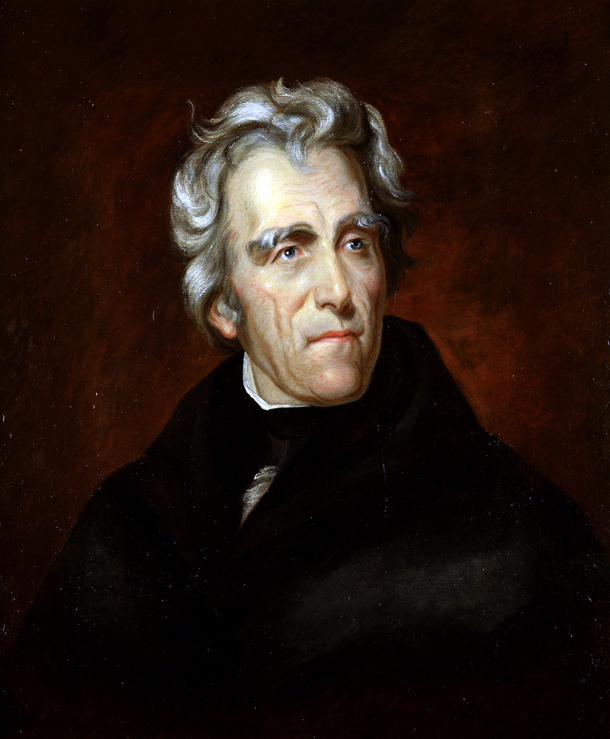
Andrew Jackson, the 7th
president of the U.S. Image
from wikipedia.org.
This lesson centered on the presidency of Andrew Jackson. Jackson has a reputation as “the people’s president,” but a look at some of his actions reveals that there might be more to the story. The essential question was: Is Andrew Jackson's long-standing reputation as "the people's president" deserved? We split into six groups, two for each topic. Each created a presentation to show the class about the three issues of the time, and used the evidence to indicate whether or not Jackson was the people’s president or not. Our group used Chatterpix in conjunction with Videolicious to describe the Bank Wars (part 1 and part 2).

The first issue, about the Trail of Tears, concerned the removal of Native Americans off of their land and their migration west. Jackson said that they would be safer out west rather than clash with Americans in the east, but he moved them by force, and many of them died even before they left, in concentration camps. The second issue, concerning the second national bank, became known as the bank wars. Jackson thought that the bank had too much control over the economy and only supported the rich, but vetoing its charter eventually caused an economic collapse known as the Panic of 1848. The final issue concerned what became known as the spoils system, in which people are encouraged to lean towards a political party by giving them positions of power. This eventually resulted in a million dollars being stolen by one of Jackson’s supporters.

Thursday, December 4, 2014

Early America: A Somewhat-Kind-Of-A-Democracy?

This lesson centered around early American democracy. The essential question was: How should we define democracy? How democratic was the United States in the early 1800s? Using online searches and our own knowledge, our group defined democracy as a system of government in which power distributed to law-abiding citizens by giving them the right to vote for their leaders. We analyzed sources such as a painting by George Caleb Bingham, quotes and documents from people of the time about the voting system, and various charts. The analyzed sources were put on this poster to illustrate how democratic the United States was at the time. The final verdict was that American democracy was underdeveloped at the time, but was rapidly improving.

Our poster. Each of the 5 sources got their own slip to put in the ballot box for how democratic the US is. Each
ballot has the source's analysis and a rating based on the source.

Tuesday, November 25, 2014

Revolutions About Race (Exhibit A: Latin America)

The essential question for this lesson was “Why is it essential to acknowledge human value regardless of race? How are the events in the Latin American Revolutions evidence of this social imperative?” This is an important question because the idea of recognizing someone’s humanity regardless of their race is an idea that has not entirely sunk in today. We studied the impact of race in the Latin American Revolutions through three countries: Mexico, Brazil, and Gran Colombia. In the time period, there was an entire social structure based on a person’s heritage and where they were born, stretching from peninsulares (native Spanish people) to the African slaves. Each group of the class got a revolution to create a timeline of events for and then shared with the other groups. By examining these revolutions and comparing them, we answered the essential question.

A commonality among all three of these revolutions was that they all gained independence for
Our group did our timeline on the events surrounding Gran
Colombia, a short-lived republic that included modern-day
Colombia, Venezuela, and Ecuador.
themselves from European rule: Brazil from Portugal, and Gran Colombia and Mexico from Spain. They all also had more than one leader to guide them, like how Gran Colombia had both Simón Bolívar and Antonio José de Sucre. However, these three countries took different paths to independence. Gran Colombia became a republic, but Brazil became a constitutional monarchy, while Mexico became a constitutional monarchy that eventually got overthrown and replaced with a republic. Additionally, they had different types of leaders. Gran Colombia and Mexico had Creole leaders for the most part, while Brazil had a peninsular to lead them. Race was a major player in these three revolutions. In Mexico, the majority of the army was made of people who had been suppressed by the relatively small number of peninsulares, feeling that they had just as much rights as the Spanish. After its revolution, Brazil, being ruled by a peninsular who filled the government with other peninsulares, opposed the ruler that had been put on the throne and had him abdicate, since they still weren’t getting the fair representation they wanted. Gran Colombia referred to Simón Bolívar as “the Liberator,” which would indicate that under the oppressive social structure imposed on them by Spain, they didn’t feel free, and so rebelled for their freedom.

Latin America was not the only region of the world where race became a major issue, and race is still a significant issue in our lives today. There is no caste system in America like there was in the Latin American countries before they rebelled, but the issue of race manifests itself in other ways. Just take for example the recent events in Ferguson, Missouri, a hotly contested and polarizing topic at the moment. Problems like this are signs that we still have a lot to learn about how we deal with race. We don’t necessarily need a revolution to change, but a change right now would be revolutionary.

Friday, November 21, 2014

How Should We Remember Toussaint Louverture?

The first independent country in the New World was, of course, the United States in 1776, achieving independence from Britain. But interestingly, the second New World region to reach freedom was Haiti in 1804. Like the United States, Haiti was originally a colony, and it took a revolution to reach independence. A French colony under the name Saint Domingue at the time, Haiti was inspired by the ideas behind the French and American revolutions, and built their own revolution against the slave work that went into sugar farming. At the forefront of the revolution was former slave Toussaint Louverture, who rose through the military ranks during the revolution and eventually became the first leader of Haiti. Just before Haiti was declared independent in 1804, Louverture was captured by Napoleon Bonaparte and died in jail in 1803. The father of his country, Louverture is known today as the first leader of Haiti, a liberator of the slaves, and a strategic military commander, but not necessarily in that order. Toussaint Louverture is a man that should be remembered first as a liberator of slaves, second as a strong but strict ruler, and then as a military leader.

By far, Louverture’s most important aspect was as a freedom fighter for the slaves, as it was one of the biggest parts of his life. His start came in 1791, when a slave revolt broke out in Saint Domingue. He started as a doctor, but also commanded a small group of soldiers against slavery. (Doc A) Joining the movement against slavery was the initial spark that led Louverture to the great things he did in life, and that spark burned for his entire life. Louverture’s goal wasn’t necessarily to achieve Haitian independence; as soon as the French abolished slavery in 1794, they dropped everything and began supporting the French again, even though they were still a colony. (Doc A) For Toussaint, everything, including military success, was secondary to the abolition movement. He was even willing to go up against one of the major powers of Europe to keep slavery abolished. When the French government that had abolished slavery was replaced by the conservative French Directory, it was feared that slavery would be reinstated in Haiti. To prevent this, Louverture sent a rather forceful letter, in which he states, “We have known how to confront danger to our liberty, and we will know how to confront death to preserve it.” (Doc B) This direct message says that Haitians will live free or die, as the saying goes. Because it was essential to his character, Toussaint Louverture’s strongest trait to be remembered is his determination in the fight for abolition.

Secondary to Louverture’s role in the freeing of slaves was his role as a strong but harsh leader of Haiti. He was involved in the making of the colony’s constitution when the slaves were freed, a constitution which put him at the head of Saint Domingue and “entrusted the direction thereof for the remainder of his glorious life.” (Doc C) This shows the people’s trust in Louverture to lead them well. One of Louverture’s most disliked policies as a ruler was the decision to continue sugar farming, which is labor intensive work. Though sugar was an important export and vital to the Haitian economy, the farming was work that the former slaves did not want to go back to doing, even if they were getting paid. Toussaint set strict rules on plantation workers in his proclamation in 1801, such as “Any manager or driver of a plantation upon which a foreign cultivator shall have taken refuge shall denounce him… within 24 hours under penalty of one week in prison.” (Doc D) His strict labor policy brought some to rebel against him, like his nephew Hyacinthe Moyse. Sympathetic with the former slaves who were against continuing the plantation work, Moyse allowed revolts to break out on the Northern Plain, as workers massacred white planters. Furious, Toussaint ordered an arrest and execution by firing squad. (Doc E) This was a harsh and somewhat cruel response, and while Toussaint was a good leader of Haiti, it is also important to remember his severity as a ruler. Although not the most significant thing to remember, Louverture’s position as the ruler of Haiti was key part of his life.

Toussaint Louverture was a great military commander, and it is also important to remember him as such. He was strategic, fleeing the French navy at the city of Samana and leaving them with an abandoned and burned-down town instead. (Doc F) He also taught his troops to fight in both guerilla tactics and European shoulder-to-shoulder style, giving them versatility for different situations. (Doc A) Through his knowledge of his race’s character, his humanity, generosity, and bravery, he earned the respect of his troops. (Doc F) He treated them as more than just soldiers, he treated them as fellow fighters in the battle for freedom, having given a speech where he refers to himself and the troops as “we.” (Doc F) While the military did not end up being the most crucial part of his life, it is another facet to his character that should be remembered.

Toussaint Louverture was a complex figure in Haitian history, with different facets of his life that should all be remembered, some more than others. He was most importantly the liberator of the slaves in Saint Domingue, as that was a goal that continued his entire life. Second to that was his controversial role as a leader of Haiti: he was a firm ruler, but perhaps too firm when it came to his policies on plantation labor. Finally, he was a great general, although that was a role that did not take strong precedence in his life. He was a chief figure in the history of abolition, and in world history, as a key part of the Haitian Revolution, the second free country of the New World.

Sources:
Doc A: Timeline created from various sources.
Doc B: Toussaint Louverture, "Letter to the French Directory, November 1797."
Doc C: The Saint Domingue Constitution of 1801. Signed by Toussaint Louverture in July 1801.
Doc D: Toussaint Louverture, "Proclamation, 25 November 1801."
Doc E: Madison Smartt Bell, Toussaint Louverture: A Biography, 2007.
Doc F: William Wells Brown, "A Description of Toussaint Louverture," from The Black Man, His Antecedents, His Genius, and His Achievements, 2nd edition, 1863. Engraving of Toussaint Louverture, 1802.

Sunday, November 9, 2014

And the Survey Says...

Our class’s essential question for this lesson was whether the Revolutions of 1830 and 1848 were failures, as many historians have decided. The Revolutions of 1830 and 1848 began in France, but the ideas spread to many other European regions, which also began to have their own revolutions. To determine the level of success/failure for each of the 5 revolutions we studied, we first made a small scale of complete failure to complete success and described what we thought each outcome would mean for the revolution. Then we, in groups, were each given a revolution to study, with a summary of events and primary sources. We used these to create a Surveymonkey on the revolution, which the other groups were given the information for and tested on to see how much they understood.

One of the questions of the Surveymonkey. Most
of the class got it right, citing that the Prussian king
was the enemy because he refused the crown and
constitution offered to him by the Frankfurt Assembly.
An 1848 caricature, titled "No Piece
of Paper Will Come between Myself
and My People." It illustrates King
Frederick William IV's refusal of
the Assembly and its constitution.
Source: Frankfurt Packet
Our group did the Frankfurt Assembly of 1848 (surveymonkey here). Germany, at the time, was not its own country, but rather a large group of German states, ruled by various princes. In 1848, delegates from the German states created the Frankfurt Assembly, an attempt to make Germany its own country. The Assembly eventually offered for King Frederick William IV of Prussia to dual-rule over both Prussia and Germany, considering Prussia to be more “German” than the alternative, Austria. However, King Frederick William IV, a conservative ruler, turned away their offer of a crown and constitution, since it came from the people of Germany, rather than the German princes. In his Proclamation of 1849, he explains: "...the Assembly has not the right, without the consent of the German governments, to bestow the crown which they tendered me, and moreover because they offered the crown upon condition that I would accept a constitution which could not be reconciled with the rights of the German states." Eventually, he also sent military to the Assembly, dissolving it and stopping the revolt. Some people were killed and some went to prison, but most left the country, often to the United States, where more liberal ideas had begun to take root.

The final question on the survey, where the class was
asked to rate the effectiveness of the Frankfurt Assembly.
Most of them got it in the right range, from neutral to
complete failure.
The Frankfurt Assembly was a general failure. Not many people died, but no real change occurred. In contrast, the Decembrist revolt (Russia, 1825) resulted in the deaths of near everyone involved, having been shot by troops in Senate Square. Tsar Nicholas, the Russian ruler of the time, clamped down on Russia and kept a strict rule after the revolt. And while the French revolutions in 1830 and 1848 brought about superficial changes like a new ruler, it eventually came back to a monarch: Louis Napoleon, Napoleon Bonaparte’s nephew. The Revolutions of 1830 and 1848, in one way or another, each fell in the neutral to failure category, and therefore, the movement as a whole was a failure.

Sunday, October 26, 2014

Congress Gone Wild

After Napoleon’s defeat, the various former rulers of Europe convened to figure out how to piece Europe back together and how to prevent another Napoleon from happening. Hosted in Austria, most thought the Vienna meetings, full of diplomats and royalty, would take 6 weeks or so, but excitement for peace turned the Congress of Vienna into a near-party for the participants, and it took 9 months for them to finalize everything. In class, we studied what people in power, like Prince Klemens von Metternich of Austria, did when their power was threatened by an outside force, like Napoleon. In groups, we were given some problems that needed to be addressed at the Congress of Vienna. We were also given a set of choices, and had to pick the one that Prince Metternich, a strong conservative, would have suggested. We then put our answers on this Padlet and compared with our classmates, also discussing what the Congress of Vienna really chose to do.

The diplomats from each of the five major powers of Europe. From left to right: Prince Metternich (Austria),
Prince Charles-Maurice de Talleyrand (France), King Frederick William III (Prussia), Viscount Castlereagh (England), and Czar Alexander I (Russia). All images from wikipedia.org.

One aspect of the Congress of Vienna’s decisions that we discussed was the Principle of Intervention. All but one (England) of the representatives at the Congress of Vienna decided that if any one of them was having difficulties putting down a revolution, the others could send in military to squash it themselves and restore the original monarchy. This came into play in the 1820s, when Austria crushed an Italian nationalist uprising, and when Louis XVIII of France sent his army to crush a rebellion in Spain. This principle, which supported conservatism, made sure to prevent any liberalism or nationalism taking hold in Europe (though it did not protect against revolutions taking place in the New World).

I think this was a poor decision by the Congress of Vienna. Squashing all movement for change does not stop it, only postponing change to come later and much angrier. In 1848, Austrian revolutions forced Metternich to flee Vienna and lose power. Instead, the rulers should have applied some liberal ideas, which would have caused them to lose some power, but would have prevented the rebellions against them in the first place.